


























Key Takeaways
- Rapid Market Growth: Earthwork estimating software is expanding globally as contractors adopt digital tools to improve estimating accuracy, bidding efficiency, and cost control.
- AI and Cloud Adoption Accelerates: AI-powered takeoffs, cloud estimating, BIM integration, drones, and digital twins are transforming traditional earthwork estimation workflows.
- Infrastructure Spending Drives Demand: Trillions in global infrastructure investment are increasing demand for faster, more accurate earthwork estimating software across construction and civil engineering.
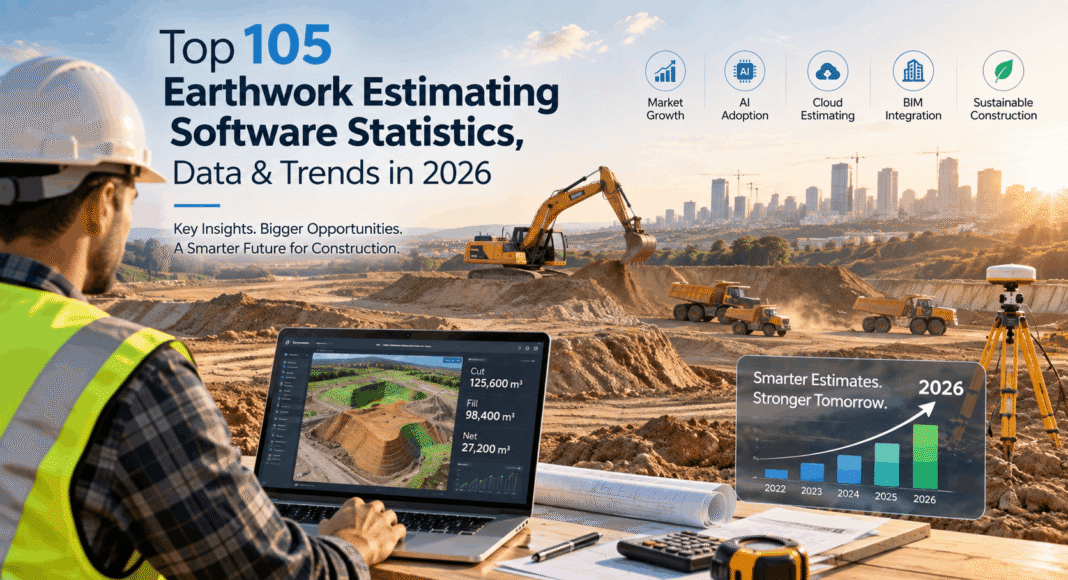
Earthwork estimating software improves construction cost planning by automating quantity takeoffs, increasing estimating accuracy, and reducing bid preparation time. In 2026, growing infrastructure investment, cloud adoption, AI-powered estimating, BIM integration, drones, and digital twins are accelerating its use across excavation, civil engineering, residential, commercial, and industrial construction projects.
The global construction industry is entering a new era of data-driven estimating, automation, and digital project management, making earthwork estimating software an increasingly important technology for contractors, estimators, civil engineers, and infrastructure developers in 2026. As construction projects become larger and more complex, accurately calculating excavation volumes, cut-and-fill requirements, material quantities, labor costs, and equipment needs can have a significant impact on whether a project remains profitable and on schedule.
Also, read our article on the Top 10 Earthwork Estimating Software.
The statistics demonstrate the scale of this transformation. The global Earthwork Estimating Software market was valued at approximately $1.864 billion in 2024 and is projected to reach around $3.5 billion by 2035, representing a forecast 5.9% CAGR between 2025 and 2035. Other industry estimates point to even faster expansion, including projections of 9.8% and 10.5% annual growth, illustrating strong expectations for continued adoption across the construction technology ecosystem.
One of the biggest forces behind this growth is the persistent problem of inaccurate construction planning and cost estimation. According to the statistics compiled for this report, 85% of construction projects experience cost overruns, while 98% of megaprojects face cost overruns or delays. Large infrastructure projects have historically experienced average cost overruns of approximately 28%, while construction inefficiencies have been estimated to cost the global economy as much as $1.6 trillion annually. These challenges create a compelling business case for contractors to replace fragmented spreadsheets and labor-intensive estimating processes with specialized digital tools.

The potential productivity gains are equally significant. Construction estimating software can reportedly deliver a 50% improvement in estimation accuracy, reduce cost estimation errors by 31%, improve budget planning by 30%, and shorten bid preparation time by as much as 40%. AI-powered earthwork quantity takeoff systems can also save estimators as much as 20 hours per week, allowing teams to process more tenders while dedicating less time to repetitive manual measurements and calculations.
Cloud computing and artificial intelligence are further reshaping the market. Cloud solutions represented more than 51% of construction estimating software deployments in 2024, while more than 66% of estimating tools are forecast to be cloud-based by 2027. Meanwhile, 74% of architecture, engineering, and construction firms are already using AI in at least one phase of their projects, suggesting that automated takeoffs, predictive cost modelling, intelligent quantity calculations, and AI-assisted bidding could become increasingly important components of modern estimating workflows.
The opportunity is also being reinforced by enormous infrastructure investment worldwide. Annual global infrastructure spending stood at approximately $4.4 trillion in 2024 and is projected to rise substantially over the coming decades, while cumulative infrastructure investment between 2024 and 2050 is forecast to reach $151.1 trillion. Asia-Pacific alone accounts for a major proportion of global construction and infrastructure activity, while large government programmes in the United States, India, Saudi Arabia, and other markets continue to create demand for earthworks-intensive roads, bridges, utilities, industrial facilities, housing developments, and transportation projects.
Against this backdrop, understanding the latest earthwork estimating software statistics, data, market trends, adoption rates, AI developments, cloud technology trends, and industry forecasts for 2026 can provide valuable insight into where construction estimating is heading next. This comprehensive collection of the Top 105 Earthwork Estimating Software Statistics, Data & Trends in 2026 examines the numbers shaping the industry, from market growth and regional adoption to productivity improvements, BIM integration, digital twins, infrastructure spending, mobile estimating, adoption barriers, sustainability, and the evolving competitive landscape.
Before we venture further into this article, we would like to share who we are and what we do.
About 9cv9
9cv9 is a business tech startup based in Singapore and Asia, with a strong presence all over the world.
With over ten years of startup and business experience, and being highly involved in connecting with thousands of companies and startups, the 9cv9 team has listed some of the top and best companies/tools in this review.
If you like to get your company listed in our top B2B software reviews, check out our world-class 9cv9 Media and PR service and pricing plans here.
Top 105 Earthwork Estimating Software Statistics, Data & Trends in 2026
📊 MARKET SIZE & GROWTH
- $1.864 Billion — Global Earthwork Estimating Software market was valued at USD 1,864.7 million in 2024, establishing a strong baseline for the decade-long growth trajectory ahead.
- $1.974 Billion — The market is projected to reach USD 1,974.7 million in 2025, reflecting strong year-on-year momentum driven by infrastructure digitalisation.
- $3.5 Billion — By 2035, the global Earthwork Estimating Software market is expected to double in value to USD 3.5 billion, underpinned by rising construction complexity and AI adoption.
- 5.9% CAGR (2025–2035) — The earthwork estimating software market is forecast to grow at a 5.9% compound annual growth rate over the 2025–2035 period, outpacing general software markets.
- $1.2 Billion — An independent estimate (DataHorizzon Research) valued the global earthworks estimating software market at approximately USD 1.2 billion in 2024, slightly more conservative but equally bullish on growth.
- $2.8 Billion — DataHorizzon Research projects the market to reach USD 2.8 billion by 2033, representing a robust 9.8% CAGR and underscoring growing cross-sector demand.
- 9.8% CAGR (2025–2033) — At nearly 10% annual growth, earthworks estimating software is among the fastest-growing vertical SaaS niches in the construction technology ecosystem.
- $14.55 Billion — The broader Earthworks Software market (inclusive of 3D modelling, machine control, and site mapping) was valued at USD 14,550.75 million in 2024, highlighting the wider opportunity.
- $29.52 Billion — The broader earthworks software market is projected to reach USD 29.52 billion by 2032, growing at an 8.2% CAGR — nearly doubling within eight years.
- 8.2% CAGR (2025–2032) — The broader Earthworks Software category grows at 8.2% CAGR, signalling robust long-term tailwinds for all players in the earthwork estimation ecosystem.
- $0.78 Billion (2023) — Verified Market Reports valued the earthworks estimating software market at USD 0.78 billion in 2023, confirming rapid acceleration heading into 2024.
- $1.87 Billion (2030) — The same market is expected to reach USD 1.87 billion by 2030, growing at a 10.5% CAGR — one of the steeper forecasts in the literature.
- 10.5% CAGR (2023–2030) — A 10.5% growth rate projection for the earthworks estimating software segment points to a structurally strong market driven by digital-first construction firms.
- $42.45 Billion (2024) — The broader global Construction Estimating Software market was valued at USD 42.45 billion in 2024, of which earthwork/excavation tools represent a key, fast-growing subcategory.
- $65.53 Billion (2032) — Global construction estimating software is projected to reach USD 65.53 billion by 2032 at a 5.57% CAGR, reflecting deep market penetration across all construction verticals.
- $1.5 Billion (2024) — Grand View Research independently valued the construction estimating software market at USD 1.5 billion in 2024, projected to hit USD 2.62 billion by 2030.
- 10.2% CAGR (2025–2030) — Grand View Research projects a 10.2% CAGR for construction estimating software through 2030, driven by BIM integration and cloud delivery.
- $921.1 Million (2025) — One segment-specific estimate values the construction estimation software market at USD 921.1 million in 2025, growing to over USD 1.3 billion by 2033 at 4.8% CAGR.
- $1,934.1 Million (2025) — GlobalGrowthInsights values the global construction estimating software market at USD 1,934.1 million in 2025, with a 7.19% year-over-year growth rate.
- $2,073.2 Million (2026) — By 2026, construction estimating software is expected to reach USD 2,073.2 million, reflecting steady near-term compounding even amid macroeconomic headwinds.
🌍 REGIONAL BREAKDOWN
- 38% North America — North America holds approximately 38% of the global earthwork estimating software market, driven by high infrastructure investment and early technology adoption.
- 36.4% North America (Earthworks Software) — In the broader earthworks software category, North America is expected to capture a 36.4% market share as the fastest-growing major region by 2032.
- ~30% Asia-Pacific — Asia-Pacific accounts for approximately 30% of the earthworks estimating software market and is the fastest-growing regional segment globally.
- ~18% Europe — Europe holds around 18% of the market, driven by strong BIM mandates, government digitisation programmes, and a mature construction industry.
- ~8% Middle East & Africa — The MEA region holds roughly 8% market share, with high infrastructure spending — particularly in Saudi Arabia and UAE — driving accelerating software adoption.
- ~6% Latin America — Latin America represents approximately 6% of the market, with emerging adoption concentrated in Brazil, Mexico, and Colombia’s urbanisation-driven construction boom.
- 46% APAC Construction Spending — Asia-Pacific accounts for nearly 46% of all global construction spending in 2026, making it the world’s largest single construction market by volume.
- 8.8% US CAGR (2025–2030) — The US construction estimating software market is expected to grow at 8.8% CAGR from 2025 to 2030, outpacing the global average due to infrastructure spending mandates.
- 38% North America Deployments — North America accounts for approximately 38% of all documented estimating service deployments globally, reinforcing its leadership position.
- India 8.1% Growth (2025) — India recorded 8.1% construction output growth in 2025, among the strongest performers globally, significantly boosting earthwork software demand.
🏗️ INDUSTRY PAIN POINTS DRIVING ADOPTION
- 98% of Megaprojects Face Overruns — 98% of megaprojects experience cost overruns or delays, with the average cost increase reaching 80% of the original project value — a crisis earthwork software directly addresses.
- 85% of Projects Experience Cost Overruns — 85% of construction projects experience cost overruns, primarily due to inaccurate estimates and poor communication between project teams.
- 90% of Large Infrastructure Projects Exceed Budget — Flyvbjerg’s landmark research found that 90% of large infrastructure projects go over budget, with an average overrun of 28% of the original estimate.
- $1.6 Trillion Annual Cost of Construction Inefficiency — McKinsey estimates that global construction inefficiencies cost USD 1.6 trillion annually, with overruns ranging from 20% to 45%, pointing to massive savings potential.
- 28% Average Cost Overrun — The average infrastructure project runs 28% over its original budget, a persistent challenge that precision estimating software is specifically designed to reduce.
- 35% Non-Productive Time — 35% of construction professionals’ time is spent on non-productive activities such as administrative errors, rework, and managing unforeseen changes.
- 20 Months Average Schedule Slippage — The average construction project slips 20 months from its original schedule, with inaccurate earthwork estimation being a primary root cause.
- 71% Report Manual Estimation Errors — Over 71% of construction firms reported significant errors in manual estimation in 2024, directly prompting migration to digital earthwork estimating tools.
- $1 Trillion Productivity Gap — Improving productivity in the construction industry could save nearly USD 1 trillion annually, according to McKinsey — with software adoption as a central lever.
- 70% UK Projects Exceed Budget — The UK’s National Audit Office reported that 70% of public construction projects exceeded their budgets, averaging 18% overruns — driving government-backed software adoption mandates.
⚡ EFFICIENCY GAINS FROM SOFTWARE ADOPTION
- 50% Boost in Estimation Accuracy — Adopting construction estimating software delivers a 50% boost in estimation accuracy, one of the most compelling ROI metrics for procurement decision-makers.
- 40% Reduction in Bid Preparation Time — AI-enabled estimating platforms trim bid preparation time by up to 40%, allowing contractors to submit more competitive bids faster.
- 31% Reduction in Cost Estimation Errors — Software solutions reduce cost estimation errors by 31%, directly strengthening contractor competitiveness in fast-moving tender cycles.
- 30% Improvement in Budget Planning — Firms using earthwork estimating software report 30% improvement in budget planning accuracy, helping to protect thin construction margins.
- 15% Faster Project Bids — Software adoption delivers 15% faster bid turnaround times, giving firms a tangible competitive edge in time-sensitive public and private tenders.
- 19% Faster Turnaround on Heavy Civil Projects — Estimation tools reduce turnaround times by 19% in heavy civil projects involving over 1,000 line items, a critical benefit for large-scale earthwork contracts.
- 85–90% AI Price Forecast Accuracy — AI-enabled platforms now deliver 85–90% price-forecast accuracy, compared to significantly lower manual benchmarks, according to Mordor Intelligence.
- 20 Hours/Week Saved per Estimator — AI-powered earthwork quantity takeoff tools save up to 20 hours per week per estimator, replacing time-consuming manual tracing in tools like Bluebeam and AGTEK.
- 23% Budget Forecast Accuracy in Residential — Estimation tools improved accuracy in budget forecasts by 23% for residential developments with over 50 housing units.
- $10,000s Saved Annually per User — One customer of Propeller saves USD 10,000–20,000+ per year through earthwork software, with some reporting 10–20 hours of time savings per week.
☁️ CLOUD, AI & TECHNOLOGY TRENDS
- 51% Cloud Deployment (2024) — Cloud-based solutions accounted for over 51% of construction estimating software deployments in 2024, with this share growing rapidly year-on-year.
- 66% Cloud Adoption by 2027 — More than 66% of construction estimating tools are forecast to be cloud-based by 2027, reflecting an accelerating SaaS shift across the industry.
- 63% Subscription Pricing Coverage — Subscription-based pricing models now cover 63% of the construction estimating software market, dramatically lowering the barrier to entry for SMEs.
- 58% Subscription License Share (2024) — The subscription license segment accounted for the largest revenue share of over 58% in 2024, confirming recurring-revenue SaaS as the dominant delivery model.
- 21% AI Feature Adoption (2024) — AI features such as predictive cost modelling were adopted by 21% of new software products released in 2024, with rapid acceleration expected through 2026.
- 74% of AEC Firms Using AI — 74% of AEC (architecture, engineering, and construction) firms are already using AI in at least one project phase, according to a 2025 industry survey.
- $4.86B AI in Construction (2025) — The global AI in construction market is projected to grow from USD 4.86 billion in 2025, signalling a massive and maturing investment cycle.
- $22.68B AI in Construction (2032) — AI in construction is forecast to reach USD 22.68 billion by 2032, pointing to deep integration of machine learning across all construction workflows, including estimating.
- 28% Cloud Sync Speed Improvement — 5G network expansion has improved cloud syncing speeds by up to 28%, directly benefiting remote and geographically dispersed construction site teams.
- 67% Increase in Digital Adoption (Since 2020) — Digital technology adoption in construction has increased by 67% since 2020 per the OECD’s Construction Industry Report 2024, with estimating software among the top implementations.
🛰️ BIM, DRONES & DIGITAL TWINS
- 52% Digital Twin Adoption (AEC Leaders) — 52% of AEC and asset management leaders are implementing digital twins as of 2025–2026 surveys, rising to 67% among owners focused on operational efficiency.
- 20% Timeline Reduction via BIM — BIM adoption reduces project timelines by an average of 20%, while also cutting costs by 15% and decreasing documentation errors significantly.
- 15% Cost Reduction via BIM — Alongside timeline savings, BIM-integrated workflows reduce project costs by an average of 15%, delivering compounding ROI when paired with earthwork estimating tools.
- 60% Reduction in Manual Site Walks — Weekly drone flights can reduce manual site walks by 60%, with drone data feeding directly into BIM and earthwork estimating platforms for real-time project dashboards.
- 40% Reduction in Project Documentation Time — Digital twin technologies cut project documentation time by 40% in case studies conducted in Arizona in 2025, directly streamlining earthwork progress reporting.
- $64.87B Digital Twin Market (2025) — The digital twin technology market is valued at USD 64.87 billion in 2025, forecast to reach USD 155.01 billion by 2030 as construction and infrastructure drive adoption.
- 31% AI Readiness Growth in AEC — 31% of AEC respondents in a RICS survey reported growing readiness to integrate multiple forms of AI into their estimating and project management workflows.
- 112+ Countries Using Estimation Software — Over 112 countries reported the use of estimation tools in public infrastructure tenders in 2024, confirming the truly global reach of the software category.
🏢 MARKET SEGMENTS & ENTERPRISE ADOPTION
- 60% Large Enterprise Revenue Share — Large enterprises accounted for over 60% of construction estimating software revenue in 2024, driven by integrated workflow requirements and large project volumes.
- 58% Mid-sized & Large Firm Adoption — Nearly 58% of mid-sized and large construction firms use estimating software, with adoption rates rising annually as digital mandates tighten.
- 46% Cloud Platform Adoption (Mid/Large Firms) — 46% adoption rate of cloud-based estimating platforms among medium and large construction firms has been recorded, with SME uptake accelerating rapidly.
- 45% Commercial Construction Share — Commercial construction projects account for 45% of all estimating service deployments, making it the largest single application segment globally.
- 35% Residential Segment Share — Residential construction makes up approximately 35% of estimating service deployments, with strong demand for affordable, mobile-friendly tools.
- 27% Residential App Market Share — Residential projects account for 27% of the specific earthwork estimating software market, with over 490,000 users globally applying the technology for housing projects.
- 29% Industrial Use Case Share — Industrial applications (energy, water, and manufacturing) represent 29% of earthwork estimating software adoption, with 170,000+ users applying it to industrial tenders.
- 20% Infrastructure Estimating Services Share — Infrastructure projects account for 20% of the estimating services market split globally, with rising public investment expected to push this share higher.
- 20% Infrastructure Segment — Infrastructure and civil engineering represent approximately 20% of the estimating service market, with this segment growing fastest as government-backed programmes expand.
💸 INFRASTRUCTURE SPENDING DRIVERS
- $4.4 Trillion Annual Global Infrastructure Spending (2024) — Global infrastructure spending was USD 4.4 trillion annually in 2024, forecast to rise to USD 6.9 trillion by 2050 per PwC’s Global Infrastructure Outlook.
- $151.1 Trillion Cumulative Infrastructure Investment (2024–2050) — Across the 25-year period, cumulative global infrastructure investment is forecast to reach USD 151.1 trillion — double the pace of the past 20 years.
- $1.2 Trillion US Infrastructure Act — The US Infrastructure Investment and Jobs Act allocated USD 1.2 trillion over five years, with approximately USD 110 billion designated for roads, bridges, and earthworks-intensive projects.
- $110 Billion for US Roads & Bridges — Of the US infrastructure package, USD 110 billion is specifically earmarked for roads, bridges, and major projects requiring extensive earthworks operations.
- $1.4 Trillion India NIP — India’s National Infrastructure Pipeline is valued at INR 111 trillion (~USD 1.4 trillion) through 2025, generating massive demand for scalable earthwork estimating software across Asia-Pacific.
- 8% Infrastructure CAGR Through 2030 — Global infrastructure projects are expected to expand at nearly 8% CAGR through 2030, supported by major government spending programmes in transportation, clean energy, and utilities.
- 4.0% Infrastructure Construction CAGR (2025–2026) — The infrastructure construction market grew at a 4.0% CAGR from USD 3,561.32 billion (2025) to USD 3,703.52 billion (2026), sustaining demand for estimation tools.
- $4,284 Billion Infrastructure Market (2030) — Global infrastructure construction is expected to reach USD 4,284.14 billion by 2030, with earthwork estimating software integral to cost management at this scale.
- 13% of Global GDP — Construction accounts for approximately 13% of global GDP, with infrastructure projects representing 38% of total construction spending across major economies.
- 60% APAC Infrastructure Spending Share — Asia-Pacific countries are expected to account for at least 60% of all global infrastructure spending, making it the single most important region for earthwork software growth.
- Saudi Arabia 4% Construction Growth (2025) — Saudi Arabia recorded 4% construction output growth in 2025 among the strongest performers in the Middle East, fuelling regional earthwork software demand.
🚧 ADOPTION CHALLENGES & BARRIERS
- 42% Cite Cost Barriers — 42% of firms cite cost barriers as the primary challenge to adopting earthwork estimating software, highlighting the importance of subscription pricing and freemium tiers.
- 28% Cite Integration Issues — 28% of firms report integration issues with existing construction management platforms as a key obstacle, underscoring the need for open APIs and BIM connectivity.
- 20% Report Training Gaps — 20% of potential users report user training gaps as a barrier to adoption, pointing to a product differentiation opportunity around onboarding and in-app guidance.
- 37% SMEs Cite Budget Constraints — 37% of small contractors identify limited budgets as the main restraint to adopting external estimating software, a challenge cloud-based subscription models are actively addressing.
- 10% Struggle with Digital Literacy — 10% of potential users specifically struggle with digital literacy, representing an underserved segment that could be unlocked through simplified UX and mobile-first design.
- 92% of Contractors Struggle to Fill Positions — About 92% of contractors find it hard to fill open positions, meaning software that reduces manual labour in estimating is no longer optional — it’s essential.
- 45% Faced Project Delays Due to Labour Shortages — 45% of contractors faced project delays because they or their subcontractors couldn’t find enough workers, amplifying the ROI of automation software.
📱 MOBILE & USER EXPERIENCE
- 58% of Residential Tools Offer Mobile Support — 58% of earthwork estimating tools targeting residential construction offer iOS and Android apps, reflecting the growing expectation for mobile-first workflows.
- 490,000+ Residential Software Users — Over 490,000 users globally applied earthwork estimating software for residential housing projects in 2024, demonstrating broad market penetration beyond enterprise contractors.
- 170,000+ Industrial Tender Users (2024) — Over 170,000 users applied estimation software in industrial tenders during 2024, confirming rapid adoption in the energy and manufacturing construction verticals.
🌱 SUSTAINABILITY & ESG
- Reduced Carbon via Volume Optimisation — Earthwork estimating software optimises cut-and-fill volumes to minimise unnecessary excavation, directly reducing fuel consumption by machinery and lowering project carbon footprints.
- 38% Green-Certified Construction Projects (Europe) — Green-certified projects represented approximately 38% of total developments by leading European construction groups, with software-driven material optimisation central to sustainability targets.
- 24% Operational Performance Improvement — Energy-efficient building systems enabled by construction software improved operational performance by approximately 24% in leading European construction programmes.
- $155.01B Digital Twin Market (2030) — As digital twins scale to USD 155.01 billion by 2030, their integration with earthwork estimating software will be key to real-time sustainability monitoring on construction sites.
📈 COMPETITIVE LANDSCAPE
- Top 2 Providers Hold 18–22% Combined Share — The top two estimating service providers capture roughly 18–22% combined share globally, indicating a fragmented but consolidating competitive market.
- Moderate Market Concentration — The Earthworks Estimating Software market exhibits moderate concentration, with a mix of established players (HCSS, B2W, InSite, PlanSwift) and agile AI-first innovators.
- November 2025: Autodesk Estimate Launch — In November 2025, Autodesk launched Autodesk Estimate, a cloud tool linking 2D/3D takeoffs to costs in Autodesk Construction Cloud, cutting errors and bid times.
Conclusion
The Top 105 Earthwork Estimating Software Statistics, Data & Trends in 2026 reveal an industry undergoing a significant transition from manual estimating processes toward cloud-based, AI-powered, and increasingly automated construction workflows. As contractors face tighter margins, larger infrastructure projects, persistent labor shortages, and greater pressure to submit accurate bids quickly, earthwork estimating software is becoming an increasingly valuable component of the modern construction technology stack.
Market forecasts reinforce this momentum. The global earthwork estimating software market was valued at approximately $1.864 billion in 2024 and is projected to reach $3.5 billion by 2035, representing a forecast CAGR of 5.9% from 2025 to 2035. Alternative market estimates indicate potentially faster expansion, including forecasts approaching 9.8% to 10.5% CAGR, demonstrating strong expectations for continued digital adoption across earthworks, civil engineering, infrastructure, residential construction, and industrial projects.
The business case for better estimating technology becomes particularly clear when examining construction’s persistent cost and productivity challenges. The dataset indicates that 85% of construction projects experience cost overruns, while 98% of megaprojects encounter cost overruns or delays. Average infrastructure project cost overruns have been estimated at 28%, and global construction inefficiencies are associated with approximately $1.6 trillion in annual costs. Reducing even a fraction of these inefficiencies could create substantial financial value for contractors, project owners, and governments.
Earthwork and construction estimating technologies are already demonstrating measurable efficiency improvements. Software adoption has been associated with a 50% improvement in estimation accuracy, 31% fewer cost estimation errors, 30% better budget planning, and up to a 40% reduction in bid preparation time. AI-powered quantity takeoff solutions can potentially save estimators as much as 20 hours per week, creating opportunities for construction businesses to pursue more tenders without proportionally expanding their estimating teams.
Cloud computing, artificial intelligence, BIM, drones, and digital twins are likely to accelerate this transformation further. Cloud solutions already represented more than 51% of construction estimating software deployments in 2024, with cloud penetration forecast to exceed 66% by 2027. At the same time, 74% of AEC firms are using AI in at least one project phase, while BIM-integrated workflows have been associated with approximately 20% shorter project timelines and 15% lower project costs. These technologies are increasingly connecting estimating with real-world site data, project planning, cost management, and ongoing construction monitoring.
The long-term opportunity is amplified by extraordinary levels of global infrastructure investment. Annual infrastructure spending reached approximately $4.4 trillion in 2024, while cumulative investment between 2024 and 2050 is forecast to reach $151.1 trillion. Roads, bridges, transportation networks, utilities, industrial facilities, housing developments, renewable-energy projects, and major urban infrastructure programmes will require enormous quantities of excavation, grading, cut-and-fill planning, material movement, and cost estimation.
However, adoption is not without challenges. The statistics show that 42% of firms cite cost as an adoption barrier, 28% report integration difficulties, and 20% identify training gaps. These obstacles suggest that future winners in the earthwork estimating software market may not simply be the platforms with the most advanced features. Ease of implementation, interoperability, intuitive user experiences, mobile accessibility, flexible subscription pricing, and effective onboarding could become equally important competitive differentiators.
Ultimately, the earthwork estimating software trends for 2026 point toward a construction industry where estimating becomes faster, more connected, data-driven, and increasingly intelligent. AI-assisted takeoffs, cloud collaboration, BIM integration, drone-generated site data, digital twins, predictive cost modelling, and automated quantity calculations are gradually changing how contractors evaluate projects and prepare competitive bids.
For construction companies, estimators, civil engineering firms, infrastructure developers, and technology providers, the message from these 105 earthwork estimating software statistics is clear: digital estimating is moving from a productivity advantage toward an increasingly important operational capability. Organizations that successfully combine accurate estimating technology with integrated project data and efficient workflows will be better positioned to control costs, respond to tenders faster, manage increasingly complex earthworks, and compete in a global construction market defined by enormous infrastructure investment and accelerating technological change.
If you find this article useful, why not share it with your hiring manager and C-level suite friends and also leave a nice comment below?
We, at the 9cv9 Research Team, strive to bring the latest and most meaningful data, guides, and statistics to your doorstep.
To get access to top-quality guides, click over to 9cv9 Blog.
To hire top talents using our modern AI-powered recruitment agency, find out more at 9cv9 Modern AI-Powered Recruitment Agency.
People Also Ask
What is earthwork estimating software?
Earthwork estimating software helps contractors calculate excavation, grading, cut-and-fill quantities, materials, labor, equipment, and project costs more accurately using digital takeoff and estimating tools.
How large is the earthwork estimating software market in 2026?
The market was valued at about $1.864 billion in 2024 and is projected to reach $3.5 billion by 2035, with a forecast CAGR of 5.9% from 2025 to 2035.
How fast is the earthwork estimating software market growing?
Forecasts vary by source, with projected CAGRs ranging from 5.9% to 10.5%. These estimates indicate continued growth as construction companies adopt digital estimating and automation.
What is driving earthwork estimating software growth in 2026?
Major drivers include infrastructure investment, construction cost overruns, labor shortages, cloud adoption, AI-powered estimating, BIM integration, and demand for faster and more accurate bidding.
Which region leads the earthwork estimating software market?
North America holds approximately 38% of the global earthwork estimating software market, supported by substantial infrastructure investment and relatively early construction technology adoption.
How large is the Asia-Pacific earthwork estimating software market?
Asia-Pacific represents approximately 30% of the earthwork estimating software market and is identified as the fastest-growing regional segment in the dataset.
What percentage of construction projects experience cost overruns?
The dataset reports that 85% of construction projects experience cost overruns, with inaccurate estimates and poor communication among the factors contributing to the problem.
How common are cost overruns and delays in megaprojects?
Around 98% of megaprojects experience cost overruns or delays, while the average cost increase can reach 80% of the original project value.
How much do construction inefficiencies cost globally?
Construction inefficiencies are estimated to cost approximately $1.6 trillion annually, highlighting the potential value of better estimating, planning, automation, and project management.
How much can estimating software improve estimation accuracy?
The dataset reports that construction estimating software can deliver a 50% boost in estimation accuracy, creating a strong potential business case for contractors adopting digital estimating tools.
How much can estimating software reduce cost estimation errors?
Construction estimating software can reduce cost estimation errors by approximately 31%, potentially helping contractors improve bid quality and strengthen cost control.
How much faster can contractors prepare bids with estimating software?
AI-enabled estimating platforms can reduce bid preparation time by up to 40%, while other statistics show software adoption delivering 15% faster bid turnaround times.
How much time can AI-powered earthwork takeoff software save?
AI-powered earthwork quantity takeoff tools can save estimators up to 20 hours per week by reducing repetitive manual tracing and quantity calculation work.
How does earthwork estimating software improve budget planning?
Firms using earthwork estimating software report approximately a 30% improvement in budget planning accuracy, helping contractors better forecast costs and protect project margins.
How accurate is AI price forecasting in construction estimating?
AI-enabled estimating platforms can achieve approximately 85% to 90% price-forecast accuracy, according to the statistics compiled in the dataset.
What percentage of construction estimating software is cloud-based?
Cloud-based solutions accounted for more than 51% of construction estimating software deployments in 2024, reflecting the industry’s shift toward SaaS and connected workflows.
How much construction estimating software will be cloud-based by 2027?
More than 66% of construction estimating tools are forecast to be cloud-based by 2027, demonstrating the continued transition from locally installed software toward cloud platforms.
How common is subscription pricing for construction estimating software?
Subscription-based pricing models cover approximately 63% of the construction estimating software market, making recurring SaaS pricing an important industry model.
How widely is AI used by AEC firms?
Around 74% of architecture, engineering, and construction firms are already using AI in at least one project phase, according to a 2025 industry survey cited in the dataset.
How large is the AI in construction market?
The global AI in construction market is projected at $4.86 billion in 2025 and is forecast to reach $22.68 billion by 2032, supporting further AI integration into estimating workflows.
How does BIM affect construction project timelines?
BIM adoption can reduce project timelines by an average of approximately 20%, making BIM integration increasingly valuable for connected estimating and construction management workflows.
How much can BIM reduce construction costs?
BIM-integrated workflows are associated with an average 15% reduction in project costs, alongside improvements in timelines and documentation efficiency.
How are drones used with earthwork estimating software?
Drone-generated site data can feed into BIM and earthwork platforms for progress tracking and quantity analysis. Weekly drone flights can reduce manual site walks by approximately 60%.
How important are digital twins to construction technology?
About 52% of AEC and asset management leaders are implementing digital twins, while the global digital twin market is forecast to reach $155.01 billion by 2030.
Do large construction companies use estimating software more frequently?
Large enterprises generated more than 60% of construction estimating software revenue in 2024, reflecting strong demand for integrated estimating workflows across complex projects.
How much is the world spending on infrastructure?
Annual global infrastructure spending reached approximately $4.4 trillion in 2024, while cumulative infrastructure investment from 2024 through 2050 is forecast at $151.1 trillion.
Why does infrastructure spending increase demand for earthwork estimating software?
Roads, bridges, utilities and major infrastructure projects require extensive excavation and grading. Rising investment therefore increases the need for accurate quantity takeoffs, cost estimates and earthwork planning.
What are the biggest barriers to adopting earthwork estimating software?
Cost is cited by 42% of firms as a primary barrier, while 28% report integration problems and 20% identify training gaps as obstacles to software adoption.
Is mobile support important for earthwork estimating software?
Yes. Around 58% of earthwork estimating tools targeting residential construction offer iOS and Android support, reflecting growing demand for estimating workflows accessible from jobsites.
What are the biggest earthwork estimating software trends for 2026?
Key trends include AI-powered takeoffs, cloud estimating, subscription pricing, BIM integration, drone data, digital twins, mobile workflows, predictive cost modelling, and growing infrastructure-driven demand.
Sources
WiseGuy Reports DataHorizzon Research Future Market Report Verified Market Reports Grand View Research Mordor Intelligence GlobalGrowthInsights ResearchAndMarkets Globe Newswire DataInsightsMarket DataIntelo ReportPrime MarketReportsWorld MarketGrowthReports Emergen Research McKinsey Global Institute Estimating Link Digital Construction Week Contimod PwC RIB Software Hammer Missions UAV Coach Extreme Aerial Productions iBeam.ai Propeller GlobalData OECD Buildern BuildOps HCSS